EEGLAB Current version: 7
Release notes
Download
New! Tutorial wiki
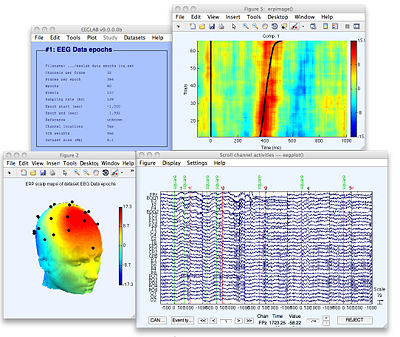
EEGLAB is an interactive Matlab toolbox for processing continuous and event-related EEG, MEG and other electrophysiological data incorporating independent component analysis (ICA), time/frequency analysis, artifact rejection, event-related statistics, and several useful modes of visualization of the averaged and single-trial data. First developed on Matlab 5.3 under Linux, EEGLAB runs on Matlab v5 and higher under Linux, Unix, Windows, and Mac OS X (Matlab 7 recommended).
EEGLAB provides an interactive graphic user interface (GUI) allowing users to flexibly and interactively process their high-density EEG and other dynamic brain data using independent component analysis (ICA) and/or time/frequency analysis (TFA), as well as standard averaging methods. EEGLAB also incorporates extensive tutorial and help windows, plus a command history function that eases users' transition from GUI-based data exploration to building and running batch or custom data analysis scripts. EEGLAB offers a wealth of methods for visualizing and modeling event-related brain dynamics, both at the level of individual EEGLAB 'datasets' and/or across a collection of datasets brought together in an EEGLAB 'studyset.' For experienced Matlab users, EEGLAB offers a structured programming environment for storing, accessing, measuring, manipulating and visualizing event-related EEG data. For creative research programmers and methods developers, EEGLAB offers an extensible, open-source platform through which they can share new methods with the world research community by contributing EEGLAB 'plug-in' functions that appear automatically in the EEGLAB menu for those who download them. For example, novel EEGLAB plug-ins might be built and released to 'pick peaks' in ERP or time/frequency results, or to perform specialized import/export, data visualization, or inverse source modeling of EEG, MEG, and/or ECOG data.
EEGLAB main features
- Graphic user interface
- Multiformat data importing
- High-density data scrolling
- Defined EEG data structure
- Open source plug-in facility
- Interactive plotting functions
- Semi-automated artifact removal
- ICA and time/frequency measures
- Event and channel location handling
Matlab 7.0 or later running under any operating system (Linux, Windows, Unix, Macintosh). EEGLAB will also work on Matlab 6.5 or earlier although some rare function may crash due to lack of backward compatibility. Matlab 5.3 is not supported any more. A large amount of RAM is useful - at least 512 MB (1-4 GB recommended for processing more than 32 channels). The Matlab Signal Processing toolbox is also recommended. Although EEGLAB incorporates functions to supplement functions from this toolbox (e.g., for filtering and power spectra), they are not as efficient. Component clustering functions, introduced in EEGLAB 5.0b, also uses functions from the Matlab Statistics toolbox.
EEGLAB Resources
EEGLAB Wiki section
Search the EEGLAB web site or email discussion list archive
EEGLAB Statistics
EEGLAB is a collection of about 400 Matlab functions comprising a total of 50,000 program lines, plus a 300-page EEGLAB
tutorial manual. To our knowledge, 21 user-initiated plugins have been developed for EEGLAB. Researchers from at least 88 country domains have downloaded toolbox files. Currently, EEGLAB files are downloaded 30-40 times per day, and 2500-3000 researchers participate in the EEGLAB email discussion list.
EEGLAB Workshops
The First EEGLAB Workshop was held Oct. 28-30, 2004 at the San Diego Supercomputer Center, UCSD, La Jolla CA. The Second EEGLAB Workshop was held September 17-19, 2005 at the University of Porto, Portugal. The Third EEGLAB Workshop was held in Singapore, November 15-18, 2006. The Fourth EEGLAB Workshop was held near Toulouse, France, June, 2007. The Fifth EEGLAB Workshop was held near UCSD, La Jolla CA in November, 2007. The Sixth EEGLAB Workshop in Santiago, Chile in December, 2007. The Seventh EEGLAB Workshop was held at Indiana University, Bloomington, Indiana in April 2009, the eighth again in Aspet, France, in June 2009. The ninth was held in Australia in late 2009; the 10th-12th will take place in 2010 in Finland, in Taiwan, and in La Jolla (following the Society for Neuroscience meeting). Inquire about or help plan or host future workshops.The chief EEGLAB developers are Arnaud Delorme and Scott Makeig. Its predecessor, the ICA/EEG Toolbox (1997-2001), comprised functions written by Makeig with Colin Humphries, Sigurd Enghoff, Tzyy-Ping Jung, Te-Won Lee, and Tony Bell, at the Computational Neurobiology Laboratory of Terrence J. Sejnowski at The Salk Institute, La Jolla. The first version of the integrated EEGLAB toolbox was first written there by Delorme and Makeig with subsequent contributions by Marissa Westerfield, Jörn Anemüller, Luca Finelli, Robert Oostenveld, Hilit Serby, Toby Fernsler, Nima Shamlo Bigdeley, Jason Palmer and many others. Dedicated beta testers include Andreas Romeyke (and his team) who developed a testsuite for EEGLAB, and also advanced users including Stefan Debener. EEGLAB development is now centered at the Swartz Center for Computational Neuroscience (SCCN) of the Institute for Neural Computation at the University of California San Diego (UCSD) in collaboration with the CNRS CERCO laboratory in France. Core EEGLAB maintenance and development is supported by the US National Institute of Neurological Disorders and Stroke (NINDS). An allied NIMH-sponsored project to create a Human Electrophysiology, Anatomic Data, and Integrated Tools (HeadIT) resource is underway. We welcome collaborations with users and open source developers to expand and improve EEGLAB functions and plug-in facilities.
EEGLAB is under active open-source development. Together with its user/developers, we are extending its capabilities to include resources including across-subject statistics and component clustering, cluster computing, and component source localization. User-contributed features and suggestions are welcome (see Add to EEGLAB). We plan to interconnect EEGLAB with other Matlab-compatible toolboxes including FMRLAB, a parallel toolbox for processing fMRI data, to facilitate analysis of concurrent EEG/fMRI data. To participate in open-source development, see Add to EEGLAB and/or email us at eeglab@sccn.ucsd.edu.
- Report a bug or coding suggestion via the: Known bugs and limitations page.
- Send private comments and inquiries about EEGLAB to eeglab@sccn.ucsd.edu.
- Send questions or comments about EEGLAB usage and principles, plus EEG-related news to the EEGLAB Discussion List.
Who's visited in the last 24 hours?